I have been talking with a lot of people about sharing traditional martial arts, Qi Gong, and Spiritual lineages lately.
In the modern world, being a part of a formal lineage covers a spectrum of possibilities. At one end, you have people who are formally training within a lineage for long enough to be accepted as a serious student, and be given the complete system of practice. At the other end, students may be training with teachers who hold a lineage, but haven’t yet invited their students to train at the depths which are possible. And, sometimes, the lineage itself is not very deep.
Some people, born into a famous lineage, do not bother training as much as needed, but use their fame for the usual opportunistic choices. Others train diligently, train with everyone they can, test themselves, and carry a lineage like a sacred talisman, meant for those who can carry its gifts and its weight into the future.
A Multi-Generational Relationship
I often introduce the context of a lineage as a multi-generational relationship.
That sounds obvious, but the West doesn’t hold social – familial – collaborative relationships in the same way as most of the rest of the world. Indigenous cultures and previous Chinese social norms, both honor these relationships as the most essential opportunities to keep your people, and yourself alive.
In modern life, shifting alliances happens all the time. Not that long ago, in tradition centred cultures, everyone sought generational ties, and shared obligations. Family clans around the world, still have obligations towards of from every other clan.
A functioning lineage that has successfully competed with other comparable lineages will gain respect. Both as a specialized craft, and as a necessary component of the aliveness and capacity of your village. That social responsibility and respect subsequently ensure your family’s livelihood, which means a great deal.
These are very pragmatic cultures. Most of the oldest cultures, including those that have lasted until today, hold a natural skepticism for anything that has not proven itself over a long time. Skills that became long-term traditions were chosen for being effective, making certain outcomes more efficient, and in some cases, more Spiritually profound than what everyone else has tried so far.
What a Lineage Offers
I can only speak from my experience. Training within a family or village tradition, be it martial, spiritual, or the healing arts, will always offer more than it asks.
Personally, knowing that I was no longer wandering across the proverbial landscape of life alone, was life changing and soul healing. It was and still is, like walking next to a river that most people know the name of. Imagine you have chosen to keep that river in sight. On your journey, you always have its guidance, resources, and experience available. Someday, you may be asked to tend to the relationship between the river and its visitors. Along this journey, you meet others, within a community of river students, guardians, ambassadors, as well as teachers of the river way. Some lineages have a family that goes around the world.
That does not mean you suddenly have a full-time job. It is about noticing that, as you move through your life, you also have the resources and the formal relationship, a professional relationship, a guild relationship, and a multi-generational family relationship with that lineage. Sometimes, each of us needs compass and a map to guide us on our path. Sometimes we need to float on a raft, look at the stars and flow with the current for a while.
Having that river, that current, that calling beside us is profoundly necessary and valuable.
In most lineages, this relationship does not limit your life or your options in any significant way. Today, it is normal to learn from two or three lineages for most lifelong professional teachers. Most of us represent one or more teacher’s perspective or process. This is the only way to be certain what you are learning is effective, and also understand what is available.
For many, these traditions are also Spiritual traditions that aspire to some experience of Enlightenment. Perhaps, on a certain level, this is like a life-or-death decision. A wider perspective at the beginning, on many levels, helps each of us navigate and co-create our own path and practice.
My favorite professional benefit of long-standing traditions is how clearly organized, sequentially brilliant, and organically personalized throughout the learning process they tend to be. A process that is meant to be life-long.
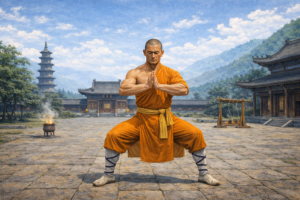
At first, there are the necessary exercises, sometimes there are choreographed routines and forms, there is training the mind and body in ways that challenge the status quo on what is possible. Having a carefully designed sequence of training for learning skills from the obvious to the subtle, or from the outside inward. Becoming skilled at anything takes ‘Gong Fu’ – developing capacities and competence over a time of dedicated practice.
As a teacher of these skills and processes, I want to share an important truth. The external forms and skill are essential. There is no other way to experience certain challenges. My role is really to help my students move through the deeper transformational experiences, as they hit speed bumps, and as they become aware of another layer of practice or existence. Moving through any transformation is much better with a trusted ally who knows, not only what is happening, but keeps you anchored in what it means.
Another treasured gift is the development of a mature personal, professional, and familial relationship with teachers and fellow students. Having had just over 40 years of access to lineage-holding teachers, and still learning from some of them today, that is a lot of any person’s life to grow up next to. These are people who deserve my respect because they have trained almost every day of their lives for decades longer than I have, and they have also carried traditional practices in a very sacred and purposeful way.
Lineages continue and grow, or disappear, depending mostly on the relationships of the people working together to move a tradition forward. I am fortunate to still have relationships with my original teacher Eric Tuttle, and other teachers I have met along the way. Every one of those relationships, with the ones who have passed, and the ones still here, holds pivotal meaning in my life. Mostly, because of what those people had chosen to become for themselves, and for their extended family.
A Family Relationship and a Lineage Relationship
Anytime a potentially lifelong and meaningful relationship comes up in a conversation, I like to share some helpful imagery.
Try this!
Please use your imagination and visualize living in a future society that is doing very well.
This society has chosen to include a very specific way that human beings hold and live with their primary relationships. In this imagined future, what all human beings have decided to do, anytime two people in an important relationship need to spend some time together, for all the possible reasons, they go on a canoe ride together.
This is called having a relation-canoe. A relation ‘ship’ is often too big and abstract for important moments to feel real.
Here are few examples, and as I go through these, this is meant to be a bit playful. If you’ve never been in a canoe with someone, just imagine being in a relatively small boat with two paddles and two people. The more challenging the waves the more you have to work together.
With Children
If you are raising a child, or have already raised children in your life, imagine living in this future where any time that quality time, that kind of love and attuned care and attention, that need for room and for things to move around within a relationship, you get in this canoe. Because, of course, that is a really good idea.
So, you and your child go for a ride. And there is nothing else to do but paddle together, work on steering together, because there is somewhere you are meant to be going together.
As the parent, you are asked to bring your best timing and attunement, either by adding to the environment by talking or being noisy, or holding some sacred silence long enough until whatever needs to be said can come from a much more heart-centered place. Children decompress their contention, confusion, emotional intensity in chaotic and expressive ways. Which is very healthy and means that they are safe enough in your presence to feel through their confusion in your presence. Not your defensiveness.
A relation-canoe ride, by its nature is patient, and holds human connection in a clear and collaborative container.
What if we all raised our children that way, because we were all raised that way. Imagine remembering every time you became viscerally wound up and existentially in crisis as a child, a trusted parent would invite you to be met and cared for while sharing a meaningful adventure.
I wonder what the world would look like if that was always step one when meeting challenges with our children.
With an Intimate Partner
Here we are, still in our mythical future, and we have found an intimate partner, a lover, a person we want to become closer to. As humans do, perhaps we become a couple, perhaps plan on raising children and share our resources. Today, that process looks like sitting down with a lawyer whose job it is to protect resources and focus on how dangerous canoe rides can be.
Historically, and therefore emotionally, we are driven to find someone who will throw in with us, or pile our shared resources into the metaphoric canoe and trust in shared intentions and needs. The experience is consistent, present, interactive and playful with the occasional splash, or rocking of the boat.
The canoe metaphor also illuminates times when it seems that only one person is doing all of the paddling, or one person keeps going in circles, or one person isn’t able to go the way they want to go anymore.
That does not mean we are tied together at the waist; it is a reminder that we are people who go on canoe rides to restore relationships when they are fractured. Or, as many relationships do, go on one last conscious paddle as we divide up the memories, harms, happy moments, and resources. Like two people born into a culture of wisdom and truth.
With a Parent at the End of Life
Now imagine that one of your parents is coming to the end of their life, and this is one of the last chances you may have to communicate with them, and have a meaningful conversation. So of course, you invite them for a canoe ride.
And in going for this ride, you get to sit as the adult, as the teenager, as the child, and truly appreciate this person. You get to feel your aloneness and your deepest connection, the potential distance between you, and any latent rage, shame, and resentment that may have grown between you both
But it’s time to meet this person as themselves, in the moment, in the honoring of the meaning and memories you share together. Image your aged parent, perhaps after a debilitating stroke, doing their best to paddle with you, even if one of their arms is not able to. Seeing them doing their best with a big smile on their face as they prepare for a very different journey.
In personal relationships, for the world to be whole, for whatever it is that the universe seems to want to do with itself to feel complete, each of us needs to find the motivation to completely release any contention in our lives, in our relationships.
To go on an actual canoe ride and sit and be and listen and speak and allow the world to become what it’s meant to be.
The Bamboo Stick of Apprenticeship
The way I envision a modern lineage relationship is similar to the relation-canoe metaphor, but in a more professional and shared purpose way.
I am finding my way to a sense of clarity about how to hold a lineage apprenticeship relationship with someone I encounter almost entirely online. Often with people who are learning to some degree from recorded material. Given the many hours of live group training interactions, and enough time for one-on-one personal interaction and other opportunities, I am becoming more comfortable and confident that the experience necessary for this kind of apprenticeship to exist is possible.
It has taken me a while to get here.
Traditionally, the teacher (Shifu) and student relationship, is like adopting someone as if you are an uncle or aunt, or a kind of village elder, agreeing to train them, often for at least a decade. That is the social custom embedded in early Chinese culture. Shifu does not mean ‘Master.’
In modern life, especially in the West, I have another playful image to share that is more about lineages and less about being a good parent, or lover, or being a good person to a parent on their last journey home.
Imagine two people driving through the wilderness at night. It is windy and raining and there is a tree lying across the road. You both get out. You both lift one end of the tree. Then you both shuffle like a goofy dance, in whatever way you find to work together, moving that tree across the road.
The way I envision that relationship over a long time, at a great distance, would be like holding on to a thin bamboo stick. Not all the time, but able to reach out and pick up and carry my end of that stick when needed. My student is carrying the other end. The ‘bamboo’ between us is always there and we have agreed to carry it together until I have taken the journey as far as I am meant to lead.
Sometimes that small stick turns into a beautiful, braided rope that allows an apprentice to grab onto it and pull themselves forward. When we need help finding our way in life, making sure we are not slipping back into bad habits, making sure we are not alone, rebuilding momentum, and gradually learning to lead in our own way.
Sometimes, as students, we find ourselves at the boundaries of belonging in a family and participating wholeheartedly. Perhaps for the first time. Agreeing to simply learn, train, refine, repeat, as we move a practice and lineage forward, while moving our own practice forward.
Teaching Two Lineages in the Modern World
Today, I find myself teaching two different lineages of internal cultivation, something that I never thought I would even have a chance to talk to people about. This is because when I learned these practices a few decades ago, there was no way to just go and learn these things. They were considered secrets held within a family tradition. They were skills I never expected to teach openly, or at all, because they were so far ‘on the fringe’ of what was even known about back then.
The Lineage as a Guild
In a formal lineage, we are in a kind of family. Although we are not necessarily in the same canoe.
Many family systems of practice, or village systems of practice, were honed over time. Their skills became specialized, and very much like any other craft, they bartered with or traded those skills of protection or healing with other people as a way of supporting their family.
For example, if you were a martial arts teacher in a small village 3,000 years ago, anywhere in the world, your job was to train enough villagers to make sure that if an enemy tribe comes over the hill, everyone is going to have more capacity to be protectors. I do not believe it is beyond anything but common sense to recognize that this has always been just a part of the human endeavor. Gathering people together, and gathering skills and resources, to make sure your people had an opportunity for a better life.
Throughout much of the last 1000 years of Chinese history, people who had the time and the ability to read, or find a teacher, inner cultivation was considered a primary aspect of just being an effective person in this world, while gaining the wisdom and support from other ‘worlds.’ To be wise, skillful, spiritually aware, and connected with lineage Ancestors was like winning a lottery, or inheriting something of great value that can be shared but not sold outright.
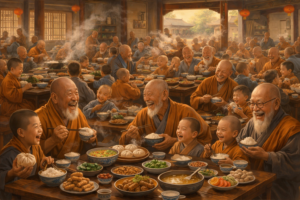
There is a term in Chinese that infers a family connection, or a clan connection, and/or a guild or specific-work connection called Guan Xi (关系). It gathers and connects people within those bonds of belonging, within those guilds and clans, at least in Chinese culture, always somewhat responsible for the well-being of each other. Today, a regular cup of tea and dim sum on a Sunday, after a couple of hours of practice, becomes something easy to maintain.
I am reminded of countless martial arts stories about bands of heroes, bandits, and pirates who went through some hilarious hijinks to complete a mythical adventure together. In every story, it was their shared Guan Xi kept them going.
A Craft is a Family Business
Finally, and the point I have been sneaking up on, all of these lineages and guilds have been a family business for a very long time. I recognize that anytime I say that out loud, you can feel something drop in people. When the primary association is on idealistic meaning, obvious benefits, implied powers, potential Spiritual awakening, how dare it be held in the container of mundane existence and a well-paying career.
These possibilities are only possible because crafts exist, they are effective, and valuable enough to seek out and learn. I have fallen prey to idealism a few times. No one values what you give away.
No one trains diligently when the outcome is no longer meaningful.
In the Chinese model, which is the common sense keep-your-village-alive model, we seek out teachers who carry lineages because they are tried and true through generations. The practices, the perspective, the philosophy, the time invested, the difficulty of what you have to go through, and the life changing benefits and skills are worth picking up and carrying one end of a stick.
Open Source, Gatekeeping, and some Lessons from Colonization
A traditional lineage has always included being a lifeway and a livelihood. That is why teachers around the world have had a natural tendency to hold things back.
What I choose to do is be transparent. Here is what I do, here is how much work it is for us to do this together. Modern life is very different with respect to free YouTube demonstration, courses that prey on superstitions, offer magical powers, and tend to teach the relatively superficial aspect of medieval Qigong where movements are attributed to benefits without an implicit interaction.
If I was just beginning as a teenager today, I would be confused, if not paralyzed, at simply knowing how to know what real training means, what it takes, and how long you have to prove yourself to be given greater responsibilities.
I suppose I am defending the family-village craftsperson’s relationship with how these practices have always been conducted within communities, to ensure that the aliveness of you family, clan, and village is better.
I sometimes have conversations with people who are very forward-thinking, wanting all knowledge to be open source, with no-gatekeeping, everyone should have access to everything all the time, no matter what.
However, when it comes to learning a process, learning the highly refined sequence and process, how to participate and interact with less-than-obvious opportunities within practices like Nei Gong, or some of the meridian work that happens in restoring one’s Dan Tian – it matters deeply who is holding the map.
If you don’t mind, I want to bring up one last potentially uncomfortable concern.
I have a very deep relationship with colonization and the Truth and Reconciliation process of the First Nations people of Canada, and the World. Colonization creates the conditions where it can demand ‘Obey, or else.’
Become and behave this way, or else there are consequences!
Colonizer consciousness says, ‘Everything is about how I (we) see the world. And, if you don’t agree that the world should look like that, I/we might go out of my way to punish you for it.’ Today, that often means being judged, harmed, devalued, and cancelled online.
What does it mean to destroy a generationally supported livelihood. Is taking away many people’s livelihood not an attack on their lives?
What does it reflect when some decide for everyone, that a family guild tradition should be dissolved, the skills and teachings watered down, and access to potentially harmful practices open to anyone?
In closing
My relationship with sharing traditional lineage practices exists only because I have met, learned from teachers, supported teachers, and was accepted as a member of a multi-generational process of transmission. I have benefited profoundly from some of the most powerful maps, and longest rivers, for how to stay the most alive, the most at peace, and the closest to the center of my heart.
As a teacher, an ‘uncle’, a Shifu, holding a piece of a living tradition, willing to adopt and train those able to commit the time and resources necessary, I am still learning. I am adapting to a much larger village online.
Strangely, learning to teach old skills in new ways has become a passion.
I can only hope this adventure allows me to share the most valuable things I have learned, with people who value the learning, the benefits, and the multi-generation project of building potential and capacity for the future village of humanity – or at least, those interested in the inner cultivation practices.
In one sense, I am really speaking for the river some choose to walk beside, tend to, and honor.
I am speaking on behalf of apprentices, and the cord or bamboo stick that guides us all when life gets dark and keeps us accountable to why these things matter as much as they do.
In the modern world, keeping a lineage intact, alive, and relevant, is its own kind of training.
May we all learn in the best ways, meet our deepest aspirations and needs, and support the guilds that have carried these gifts for so long.
Thanks for listening, or watching, or reading this.