Shaolin Nei Gong – Year One
A Shaolin Nei Gong Journey
The Yi Jin Jing system of Inner Cultivation is meant to be a lifelong journey of discovery, refinement, purification, and honoring the Sacred gift of Life. Like learning a language, it takes time to learn the words, the syntax, the grammar, and the colloquial and contemporary expressions. The rest of your journey will focus on refining the classic forms and principles, while also discovering your unique ways of expressing embodied poetry.
Year One Training
In the first year, the focus is on restoring and repairing your connective tissues. Depending on your age, medical history, posture, and previous injuries, it takes some time to develop the foundation for the Yi Jin Jing process, which includes the journey of cultivating Whole-Body Myofascial Tensegrity.
Most of the first year is focused on learning the practices, forms, principles, and methods, while also engaging in a process called Bu Que 補缺. This term implies repairing any deficits, building more whole-body connective tissues, as well as balancing and improving everything front and back, left and right, up and down, through all of your gradually increasing mass of interconnected collagen filaments and precursor gel.
As your movement skills begin to include a more complete range of motion, with enough torsion and gyration, your muscles, tendons, membranes, fascia, and deeper collagen connections become balanced and strong. Increasing muscle mass happens in two ways. One is muscle volume and the other is muscle density. This system of practice can ensure both, in whatever proportion you train for, and depending on your genetic potential.
One of the motivations for developing this system of practice has always been the ability to sit or stand very still in meditation, for very long periods of time. In meditation, this path is like walking with two feet. One step, or foot, focuses on enhancing and restoring your physical body, and the other foot takes a step towards developing a coherence of attention and intention that trains a capacity of your Mind called Yi Nian 意念, which is a coherent interactive awareness and state.
Strengthening and equalizing the resting length of your entire system of connective tissues and fascia is both simple and involved. The simple part is exploring internally generated resistance through Isotonic, Isometric, and Isokinetic training.
Imagine you are holding a pose that imitates a bodybuilder. Tensing one wrist, or an elbow, one or both arms, or even your whole body is as simple as activating the muscles on both sides of each and every joint involved. Sometimes the focus is on isolating or regulating the amount of resistance, sometimes it is isolating or ceasing movement, and often, the focus is on precise, smooth, and regulated motion under load.
This is where you explore and discern Isotonic, Isometric, and Isokinetic exercise.
Things get more involved after you discover your optimal amount of resistance (depending on your age, health, and goals), and your most engaging qualities of movement. What if your body likes spirals much more than angles?
Your practice will need to cover every dimension (front, back, left, right, up, down, twist, spiral, gyrations, undulation, hard, soft, release, receive, restore), while gently rotating all of your bones, demanding tension, torsion, and pulsation of all of your skeletal muscles and membranes. Sometimes at the same time. And to be complete, your whole Mind, Body, Breath practice also needs you to breathe skillfully and powerfully.
Each of these qualities can be applied to the Twelve Gestures of Wei Tuo and External Vigor/Elixir forms.
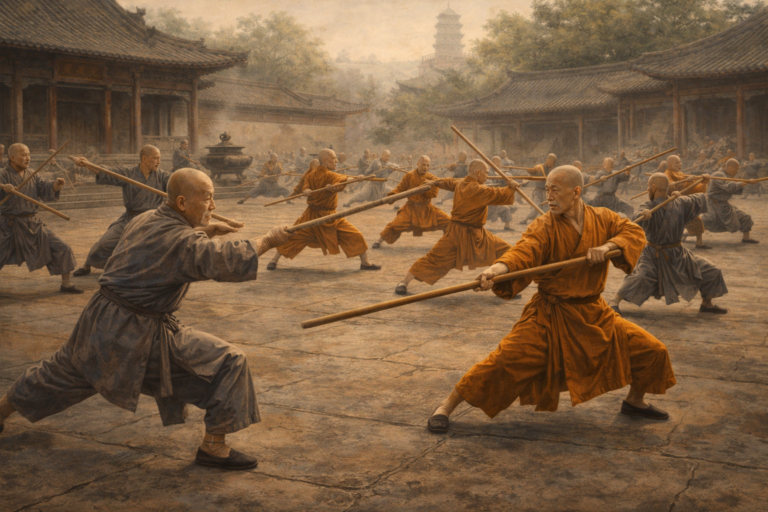
Another component of Shaolin strength training is using Stone Locks (Shi Suo 石锁) or ancient Chinese kettlebells. Again, you can choose your degree of effort and how your body changes. In the first year, this practice is usually taught as a pre-choreographed series of movements that mimic and branch off of the Twelve Gestures of Wei Tuo form.
One addition I have added to this system is called Gymitations. Gymitations are a way for people to self-assess themselves for connective tissue integrity, learn some weight free resistance training exercises that could be done later in the gym with weights, and learn the names of your major muscles.
Try a biceps curl just using dynamic tension. Now, with both arms, maintain tension in both directions. Now ensure your posture, structure, and breathing are integrated. Nice Gymitation
An unfortunate side effect of focusing a lot on resistance training is a loss of general flexibility. There are many forms of stretching and improving pliability and tone. Optimal tissue matrix includes a wide range of motion that is both dynamic and functional. Just like over-strengthening can get to the point you cannot scratch your own back, you can also over-stretch, which often striates the fascia of your back, core, and limbs. This has the opposite effect on your dynamic capacity – which could be dancing or fighting for your life.
This is why every class has a series of Dao Yin warm up and cool down exercises that ensure you won’t lose any flexibility. As well, there is an Eighteen Movement Shaolin Staff Stretching Routine. This practice is very gradual and offers some extra safety if you are just reawakening your Jin and Jing.
You can’t learn Shaolin without at least one staff form!
I encourage and teach my students to deeply explore the elasticity and pliability of all of their muscles and membranes, at least once a week if they are consciously focusing on the Yi Jin Jing process. An optimal tissue matrix is all about balance. Too much of any aspect of this practice will create an imbalance.
An unexpected and very effective way to keep your connective tissues, especially your fascia, from becoming bound or striated is a form of Percussive Massage (Pai Da). Traditionally, using bundles of wood or bamboo to gently hit your limbs and body repetitively to dissipate stagnant Qi and Blood. Today, foam rollers are more popular. One teacher recommended using a bundle of metal welding rods to create an Iron Body.
During Spring and Summer, we focus on Myofascial Tensegrity and building strength and Collagen Density. This requires a very healthy diet, potentially some traditional herbal medicine, and some ‘Secret Family Liniment’ if you get sore from training.
During Fall and Winter, and Yin begins to settle into the world, the Yi Jin Jing process goes deeper into the matrix and mojo of your fluids, gels, bones, marrow, spinal fluid and brain.
Recommendation for Your First Year
- 12 Gestures of Wei Tuo (Yi Jin Jing Form)
- Tan Fu's External Vigor (Book Two)
- Daoist Heavy Hands (Book Four)
- Shaolin Seated Wall Staring Meditation (Book One)
- The Nine Interactive Layers of Yi Jin Jing
- Dao Yin Standing Warmups, Standing Meditation, and Settling Practices
- Stone Locks (or Kettle Bells) – Version One
- 18 Gesture Staff Stretching Form
- Gymitations One – Isotonic and Isokinetic exercises for the Primary Muscles
- Circuit Training – Phase One
- Nourishing Your Tissues with Diet, Herbs and Lifestyle Yang Sheng
- Liniments and Self Massage (Pai Da One)
- Floor Work for Core Tone and Flexibility Wo Gong
- Check with your Doctor about Hypermobility and Connective Tissue Disorders
Committing at Least One Year
The First year asks for at least three hours per week of learning and practicing forms, principles, and a gradually progressing sequence of subtle interactions with your entire Jin system.
Three hours a week is the minimum to maintain and restore your contractile muscles, elastic fascia, structural membranes, sponge-like interstitium, the life restoring gels, and the lubricating electroconductive fluids. Five hours a week will guarantee progress.
The first year offers a rite of passage in transforming, purifying, and rapidly increasing your Jing/Essence – through building an External Elixir. This is a rare chance for community, accountability, Shaolin efficiency, strength, pliability, alignment, attunement, and the most sought-after Shaolin Nei Gong lineage in modern history.